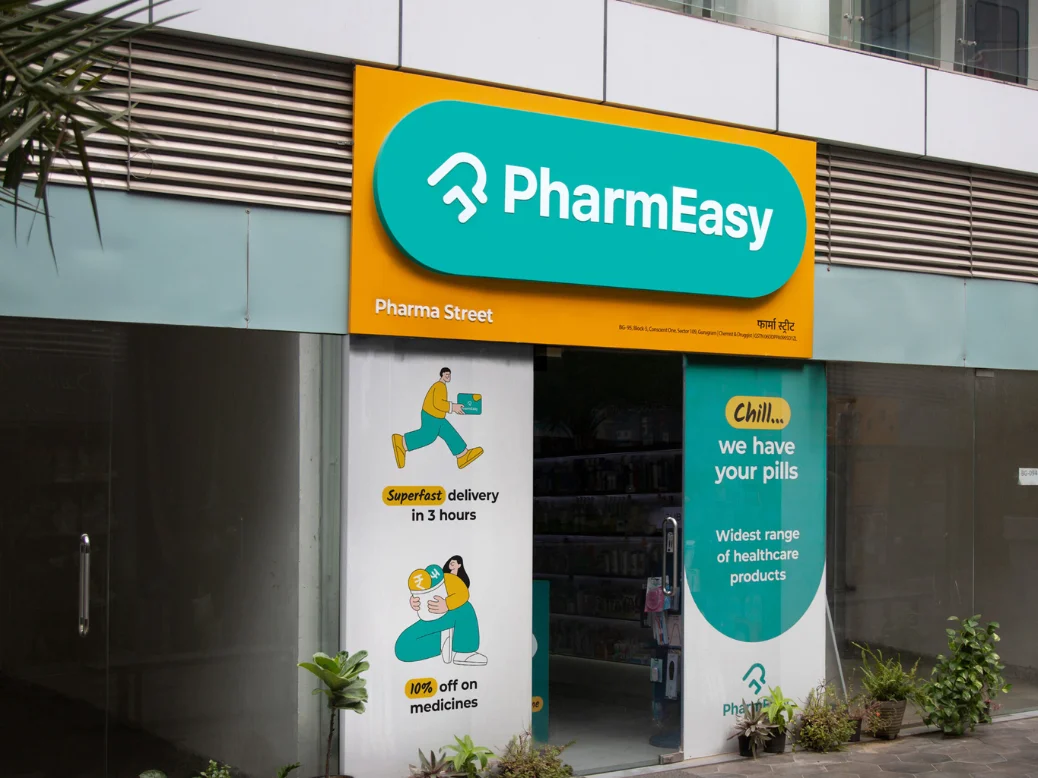
Mumbai, India: Health-tech unicorn from Mumbai, PharmEasy has recently raised Rupees 1,700 crore (around $193 million) in fresh debt financing to completely pay back its expensive loan from Goldman Sachs after suffering a sharp valuation cut of almost 90 % from its peak value.
Key Highlights
- Debt Raise: PharmEasy raised INR 1,700 crore through non-convertible debentures (NCDs) led by 360 One along with a consortium of several institutional investors.
- Use of Proceeds: The issuance proceeds will be used to eliminate a dormant $50 million Goldman Sachs loan, originally raised in May 2020 to refinance old debt related to the purchase of Thyrocare.
- Valuation: This debt infusion comes after an April 2024 capital raise (\$216M), which was done at a valuation reduction to \$710M from a prior high of $5.6 billion, nearly 90% cut in valuation.
Why This Matters
Financial Position & Strategy
PharmEasy has depended on outside funds in recent years, mixing expensive debt with equity financing as it grapples with slowing growth and a transforming competitive environment. The current debt raise serves as its third capital raising in four years, underscoring continued focus on liquidity control and debt obligations. Entrackr
Operational Context
- The Goldman Sachs loan, taken to refinance a previous Kotak Mahindra Bank loan used for the Thyrocare acquisition, carried demanding financial conditions that were breached in June 2023, though PharmEasy continued servicing payments on time.
- During the FY25 period, PharmEasy reported flat revenue (≈INR 5,872 crore) while cutting losses significantly, reflecting operational restraint alongside financial restructuring.
What This Says About PharmEasy’s 2025 Valuation
The current valuation landscape faced by PharmEasy has been a tale of drastic investor recalibration:
- Down from its high-water mark of ~$5.6 billion unto itself (earlier rounds brought serious discounting, with the April 2024 raise expecting the company to be worth around $710 million, a sharp 90% decline).
- The emphasis on debt over fresh equity indicates that investors and lenders still aren’t putting all their faith in the company, even as they provide capital to keep it from defaulting.
It is this combination of de-rating and reliance on leverage that is at the heart of the startup’s 2025 story, one where stabilisation of operations and deleveraging are top-of-the-agenda.
Investor & Leadership Notes
- The most recent funding round was led by 360 One, with debt issuance memberships coming from Micro Labs, MVS Ventures,Bennett Coleman Alkram Ventures and other investors.
- Leadership has ushered in a different kind of change over the past year, as management changes mark an internal reshuffling following recession.The reformed Ponzi scheme formerly known as WeWork.
Looking Ahead
Debt borrowing: PharmEasy’s recent debt raise to pay off a high-interest loan indicates:
- A strategic shift toward financial prudence rather than aggressive growth.
- An emphasis on deleveraging and stabilizing cash flows.
- The broader healthtech ecosystem also is watching how traction players reconcile investor expectations with operational accomplishments.
How well PharmEasy translates this write-down into long-term profitability and a rejuvenation of its valuation multiples will be one of the key narratives in the Indian startup ecosystem till 2026, if not longer.
FAQs
Q: Why did PharmEasy raise INR 1,700 crore?
A: PharmEasy raised INR 1,700 crore through debt financing to repay a high-interest $50 million loan from Goldman Sachs.
Q: How much has PharmEasy's valuation dropped?
A: PharmEasy's valuation dropped by nearly 90%, falling from $5.6 billion to around $710 million as of April 2024.
Q: What is the strategic significance of the recent debt raise?
A: The debt raise marks a shift towards financial prudence, emphasizing deleveraging and stabilizing operations rather than aggressive expansion.