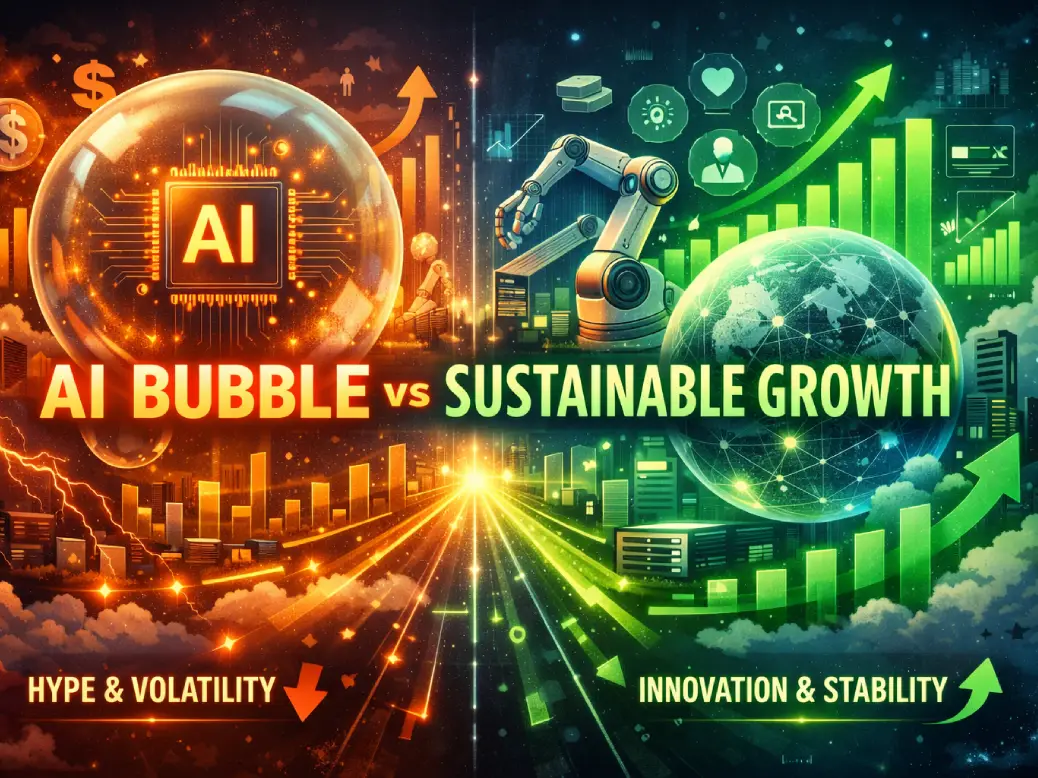
Artificial intelligence is no longer a concept of the future; instead, it has become one of the primary drivers of innovation for the modern era. From generative AI tools to enterprise automation, money pours in at unprecedented speed. However, this rapid rise has sparked a critical debate: Are we witnessing an AI bubble, or is this where the foundations of more sustainable growth in AI begin?
The debate of AI Bubble vs Sustainable AI has implications for investor sentiment, policy decisions, and long-term technology strategies worldwide.
Let's separate hype from reality by taking a closer look at what the numbers, trends, and market signals actually have to say.
Understanding the AI Bubble Narrative
By "AI bubble analysis," people mean to say that valuations, funding rounds, and expectations run a bit too far ahead of real revenue and real-world adoption. It was similar during the dot-com boom, where innovation was present, while sustainability lagged behind.
Important metrics that are usually mentioned in the analysis of the AI bubble include:
- Skyrocketing startup valuations and poor profitability
- Heavily relying on Venture Capital instead of Organic Growth in Revenues
- Overuse of “AI-powered” branding without technical sophistication
- High burn rates due to computing costs and infrastructure
Although such signals point to justifiable concerns, they do not present the entire picture.
What the Numbers Say About AI Market Growth
In spite of the reservations, the global market for AI is growing with increasing momentum. Business engagement with AI is increasing, and AI is also penetrating deeply. Long-term agreements for AI are also being incorporated in sectors such as healthcare, finance, manufacturing, and retail.
The key observations that are supported by data:
- Enterprise spending on AI has been steadily increasing from year to year
- Increasing Demand for AI Infrastructure, Chips, and Cloud Solutions
- More productivity gains are reported by companies adopting AI
- Government-sponsored initiatives and legislation on Artificial Intelligence
These numbers indicate there is hype in the market, but real demand is driving the growth of AI markets.
To read more Artificial Intelligence Guides, Articles, explore our website.
Industry Trends of AI Hint Towards Sustainability
If you look past the news, you will see that the AI industry trends today are a move from experimentation to implementation. Today, companies are no longer wondering whether to use AI, but rather how.
Leading trends driving sustainable AI development:
- Vertical Specialisation: AI Solutions for Health Care, Legal Tech, Fintech, Logistics, etc.
- Ethical Artificial Intelligence: Prioritise Transparency, Regulatory Compliance, and Ethical Use
- Cost optimisation: More efficient models use less compute and power
- Enterprise-first solutions: From short-term pilots to long-term contracts
An examination of these trends reveals the presence of a maturing ecosystem, which is evidenced by its similarity to the indicators of sustainable growth rather than speculative excess.
AI Bubble vs. Sustainable AI: A Comparative View
To understand the implications of the difference, it is helpful to examine the way in which speculative bubbles and sustainable markets usually perform:
- Bubble markets are driven very largely by hype and short-term money
- Sustainable markets are focusing on scalability, profitability, and adoption
- Bubbles invite imitators with little differentiation.
- Sustainable ecosystems favour specialisation, meritocracy, and trust
Specialisation emerges. Some areas of AI may experience hype, but there are indications of sustainability, not failure, in the overall AI landscape.
Where the Hype Ends, and Reality Begins
Not all AI startups will make it. Consolidation isn't just inevitable, it's overdue. And market correction is not market failure; in fact, it actually strengthens the long-term players.
Companies building:
- Infrastructure
- AI chips
- Enterprise SaaS tools
- Industry-specific AI platforms
They have a better chance at success than those offering general or shallow solutions. That is a crucial distinction to make when assessing various claims of AI bubble analysis.
Investor Confidence vs Market Discipline
Investor enthusiasm has certainly driven up AI's tide, yet fresh capital is now being allocated in a more disciplined manner. The investor class now demands:
- Clear ways of monetising
- Proven customer adoption
- Regulatory readiness
- Scalable architecture of AI
This shift reduces bubble risk and reinforces sustainable AI market growth.
Verdict: Bubble or Sustainable Boom?
So, is AI in a bubble? The answer is nuanced. Some valuations may be inflated, but the technology itself is not hollow. Unlike past speculative bubbles, AI is already embedded in core business operations worldwide. The numbers show a market correction underway, not a market collapse. The future of AI is refinement, regulation, and responsible scaling not hype.
FAQs
Is AI in a Bubble Today?
There are areas in the AI industry that are indicative of overvaluation; however, by and large, it has been fueled by real-world adoption and revenues.
What’s the difference between hype and sustainable growth in AI?
Indeed. The question we need to ask is Hype is concerned with the here and now of attention, whereas sustainable AI growth is based on business impact.
How Do the Trends of the AI Industry Help to Ensure Sustainability?
Vertical specialisation, responsible AI, and adoption by enterprises are indicative of a mature and stable industry.
Will companies continue to invest in AI?
Yes, but with a strategy. It makes sense to invest in tested, scalable, and industry-focused artificial intelligence tools.
Final Takeaway
The AI bubble vs Sustainable AI argument is not about the survival of AI; rather, it’s about which side will lead. And the answer is clear, the one which focuses on strategy.